Building Trust Through Seamless Authentication on WhatsApp
Role:
UX Designer
Project Overview
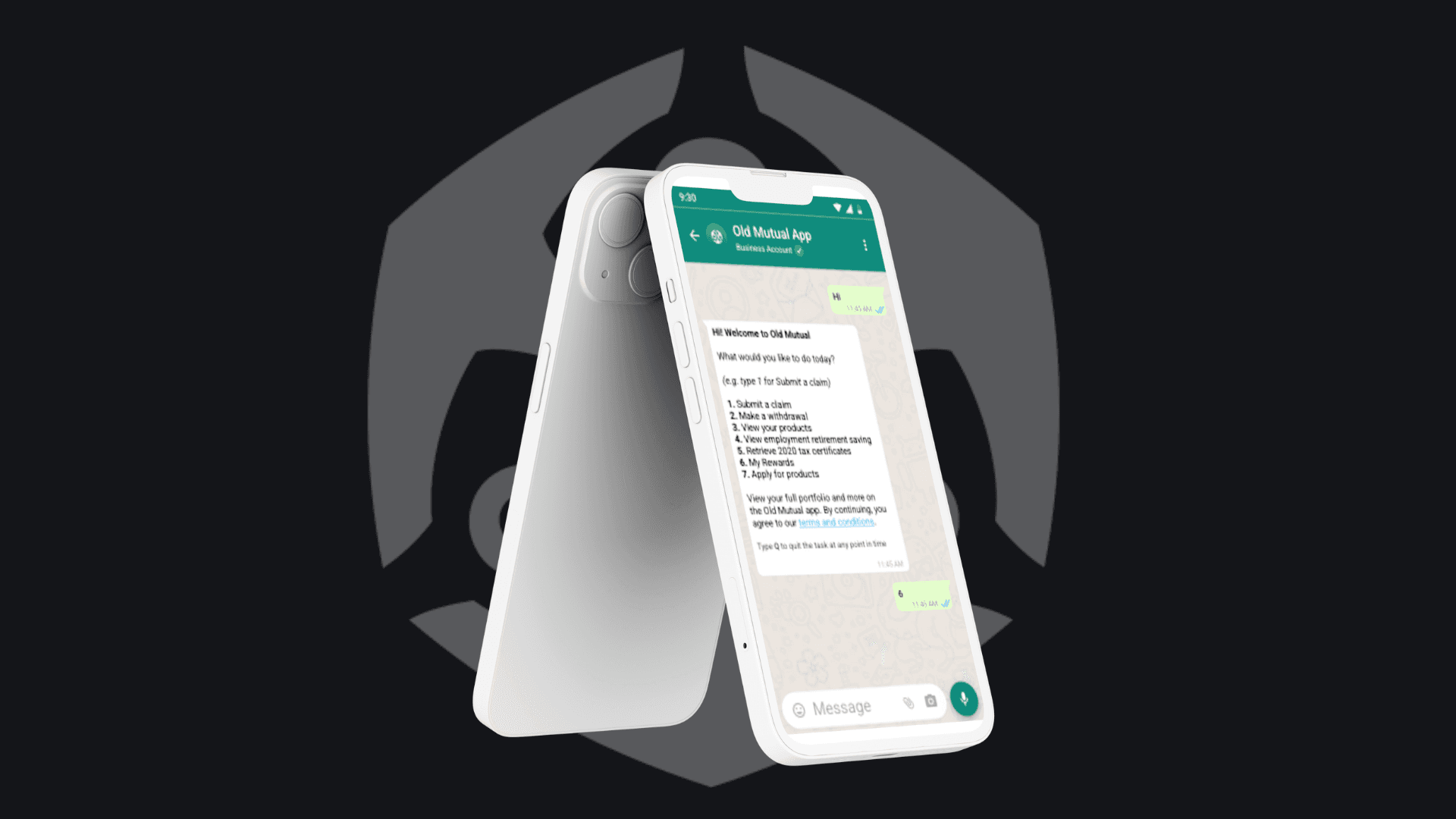
Old Mutual wanted to deepen customer engagement by enabling users to register, authenticate, purchase products, and redeem rewards directly within WhatsApp — no browser detours, no broken experiences.As a UX/UI Designer on this initiative, I was tasked with redesigning the WhatsApp registration and login flow to ensure a frictionless, secure, and trust-building user experience on a platform customers already used daily.
My Role
I joined the team as a UX/UI Designer, collaborating closely with developers, business analysts, and fellow designers. My focus was to reimagine the authentication experience within WhatsApp, ensuring it felt effortless, intuitive, and trustworthy. I worked across the entire design process — from research synthesis and journey mapping to wireframing, prototyping, and visual execution — aligning user needs with technical feasibility and business goals.
Challenge
The core challenge was seamless authentication — a process that needed to take place entirely within WhatsApp but was disrupted by the need to redirect users to a secondary platform (the web) for verification.
Key friction points:
Disruptive redirects from WhatsApp to web browsers during authentication.
Lack of feedback loop between WhatsApp and the browser, leaving users confused about next steps.
High interaction costs, increasing drop-offs and frustration.
Our goal was simple but ambitious: eliminate context-switching and create a journey that felt native to WhatsApp from start to finish.
Design Process
We anchored our approach in design thinking to ensure we solved the right problem — not just patched the symptom.
Empathise:
We ran usability audits on the current WhatsApp flow, conducted customer interviews, and reviewed contact centre feedback. A clear insight emerged: context switching broke user trust and flow.Define:
We reframed the problem into a human-centred need:“How might we enable customers to authenticate, buy, and use rewards inside WhatsApp without disruptive redirection?”
Ideate:
Through rapid ideation workshops, we explored concepts that reduced interaction costs: in-chat authentication methods, progressive verification steps, and low-friction handovers between services.Competitive Research & Future Thinking
During the ideation phase, we explored how other brands tackled similar challenges in bridging chat platforms and external authentication flows. One standout example was KFC, which implemented a seamless, in-chat authentication experience that preserved the full customer journey within WhatsApp.
Although technical limitations prevented us from implementing a similar solution immediately, we recognised the strategic potential. We documented this in our backlog as a future state opportunity, keeping an eye on evolving platform capabilities and business needs.
Forward-thinking isn’t just a nice-to-have — it’s how we future-proof the customer experience.
Prototype:
We created quick mockups and end-to-end prototypes simulating a fully-contained WhatsApp experience — where customers could authenticate, shop, and access rewards without leaving the platform.However, due to technical constraints, we ultimately introduced a browser-based authentication step to ensure security and compliance, while striving to minimise friction in the overall user journey.

We validated our assumptions through usability testing:
Customers strongly preferred staying inside WhatsApp without being redirected.
Simplified verification flows significantly reduced drop-offs and increased task completion rates.
Trust and perceived security were higher when the experience felt contained—users expressed uncertainty when asked to "leave and come back" via a browser.
Despite technical limitations that required temporary browser redirection, these findings reinforced the importance of designing for continuity, simplicity, and customer confidence.
Lesson Learnt
1. Technical feasibility doesn’t end design thinking — it shapes it.
While we initially envisioned a fully-contained WhatsApp flow, technical constraints meant we had to adapt. Instead of compromising on user experience, we designed with these realities in mind and paved a clearer roadmap for future iterations.
2. Reducing interaction costs isn't just about speed — it’s about trust.
Every additional click, redirect, or confusing step wasn’t just friction — it chipped away at user confidence. We learned that true "frictionless" design is about emotional assurance as much as efficiency.
3. Meeting users where they are matters more than ever.
Customers expected to complete their journey inside WhatsApp because it’s part of their daily behaviour. This reinforced that designing for familiar contexts (and behaviours) can drive adoption faster than novelty ever could.
4. Future-state thinking keeps momentum alive.
Although some ideas (like fully-native authentication within WhatsApp) couldn’t launch immediately, documenting them ensured we weren’t just designing for now — we were setting up a vision for next.